
By Kyle Lin (283), Maggie Gao (283), & Natalie Le (284)
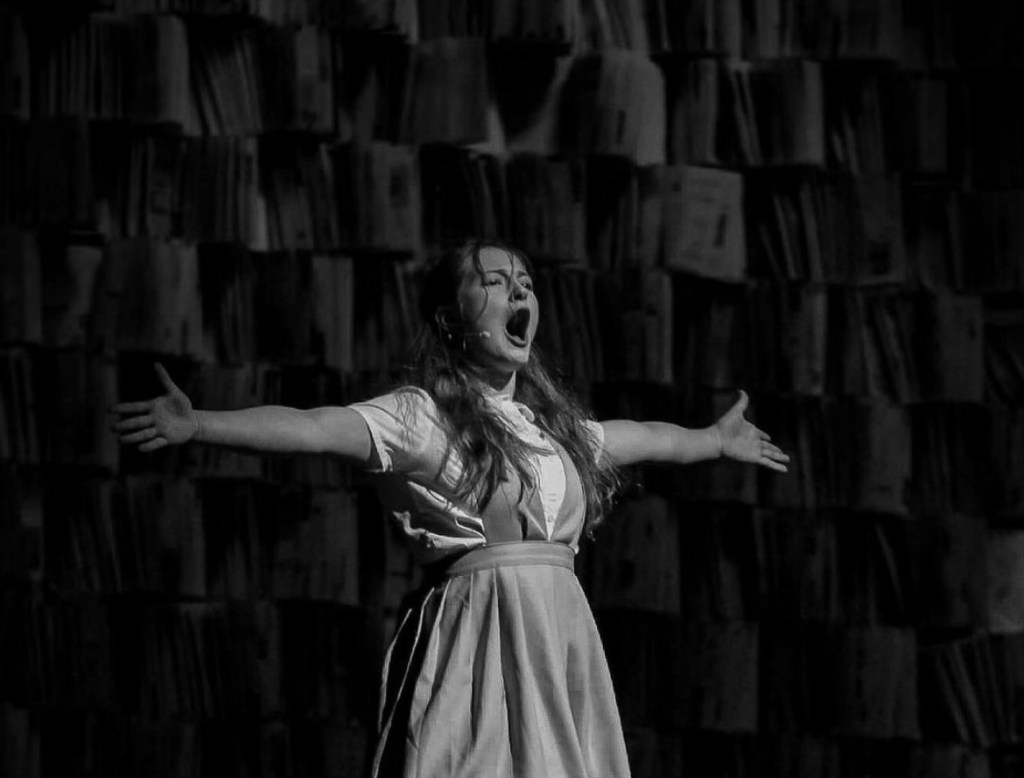
“Slow! Slow! Slow! Backwards! Backwards! Careful of the stage! Come back with the polls!” thunders Mr. Kelsey, a co-producer during the rehearsal of the musical number “Quiet” for Matilda. Ironically, interrupting Susannah Hughes (283) playing Matilda as she says, “silence, but not really silent” which leads to chuckling among the stage crew as Mr. Kelsey’s voice actually makes it not silent. Suddenly, there’s the buzzing of circular saws and whirring of hand drills, and a hive of students appear from the dark recesses of the stage, paint in hand, and start to paint a wooden platform as the music kicks back in.
These students were members of the notorious stage crew who occupied the auditorium during the early hours of the night. They’re all here, “the building department, painting department, sound department, and the lighting team,” said stage crew captain Natalie Quinn (283). “As you can see, it’s very hectic, especially now right around the time of the play, it’s crunch time and so many things still need to be made from scratch yet it’s still really fun between us all,” she says. Less than two weeks away from the show, there were still over seventy-six items that still had to be made. That evening the stage crew was able to lift one of their props that they just finished nailing together for Trunchbull and watched as it triumphantly stood on its platform for about five seconds before it came collapsing down. It’s in those moments that Valerie Qiu, the build captain of the stage crew, wished for “Dunkin to sponsor [her]” as it meant she had to stay late to figure out what went wrong and rebuild the prop so she desperately needed the caffeine. Meanwhile, in the background, the two light captains Saadiq Williams (284) and Josiah Ortiz (284) were still working to program the light show for Matilda despite finding themselves at school for over six hours on a Saturday designing the lights for only “ten minutes of actual show lights to be produced.” Frequently, Valerie would be pulled away from the building so that the light captains could ask her “a million questions” (Saadiq) to figure out the positioning of lights and take into account the musical number, clothing, character, and even the time period while creating lights to “compliment the show,” says Josiah rubbing sleep from his eyes.
“Although we do go home really late, it doesn’t feel like we’re working at times because we’re like a family,” said Valerie (284), as she rolled down the auditorium aisles on a wooden cart laughing as Irene Hong (285), the shift crew and stage management lead, pushes her. Beyond moments of tomfoolery with the stage crew, that sense of family is truly encapsulated by “the first time we got our swings put up, everyone was really excited and acted like kids again,” remarked Valerie. Reminiscing on the child-like energy everyone had when trying out the swings.
The stage crew are truly passionate about their work, even working to ensure that “the audience is incorporated, [we] decided to use the entire auditorium this year so people will feel like they’re part of the show.” (Valerie) Irene also noted that particular care was given to the aisles and to the books on stage where “fans will be blowing to make it look like the books are blowing in the wind” an aspect of the show that the stage crew spent months setting up.
Although not typical in Matilda, the inclusion of books was to highlight “Matilda’s love for reading,” said Mr. Kelsey when asked about the artistic liberties taken with Matilda this year. The two light captains Saadiq Williams (284) and Josiah Ortiz (284) both mentioned that people should be keeping a close eye on the books as we have “hung up LED lights on a pole backstage for [the book]” which will further emphasize Matilda’s love `for literature. Mr. Kelsey in many ways feels that the stage crew is an embodiment of Matilda’s story, one that’s a double “narrative and underlying story about having courage and speaking up” despite being a kid’s show. In that sense stage crew despite being the “theatrical stepchild who’s always nervous of being on stage” are able to tell their story and speak out through their work that goes on stage. Many of them will be around the night of the show wearing headsets or running around on stage putting props together in the background so always be on the lookout for the “gods of theater” (Kelsey).
The show is set to look like “traditional Matilda with some fun metallic looks for the ensemble so that they’re more glitzy and showy,” says Ms. Durkee, the teacher lead for costume design. Ash Thompson (283), a member of costume design, claimed that some of the characters like Ms. Wormwood “were new money rich type” outfits, but as for the ensemble, she claimed that “there would be something recognizable about those cardigans” for the students in the audience. That artistic vision bubbled throughout the design with bold dark reds contrasted against black, bright pink, and even…TV screens. Ava Goldman (283) and Ava Yelrick (283) found that the sewing skills they’ve gained as part of costume design have culminated in the TV skirts that the ensemble will be wearing, stating, “It’s good to know how to use a machine and sew” (Goldman) and “it’s more of a physical art which we don’t have more of at Central” (Ylerick). They held themselves to a certain standard when creating these products and some costumes like the salsa dress which took “thousands of iterations,” said Ash, especially as the concept changed over many weeks of script analysis. Like stage crew, they valued “trial and error, because you never really know how something looks” (Ash) and many have regretted that the class was only a half-year course because of the bonds they’ve managed to foster together. Ms. Durkee found that her biggest struggle has been “acquiring the materials that [she] wants to make the show as flashy as [she] imagines,” being “opposed to red and black but it was the easiest to acquire and work with but even so they’ve created some incredible costumes, even for the ensemble.”
The cast of Matilda always manages to have fun with rehearsal despite the long hours of staying after school as even cast members like “Caleb [were] sleeping backstage.” Every cast member has their moments when they are “too tired” or don’t want to go to rehearsal. Still, it always was worth it in the end as Sienna Van Rhyna (285), cast as ensemble and dance captain, says she “always feel[s] better after going than when I first walked into the auditorium,” and Samantha Sandhaus (283), cast as Miss Honey, says that “every time [she] go[es] to rehearsal, it just makes [her] feel better.” Most of the cast has never been in a school musical or finally got a solo song they are proud of, so Matilda is a new experience. Each person works hard to bring an enjoyable show for the audience as even our Matilda, Susannah Hughes (283), memorizes her long lines on the commute to school, Samantha Sandhaus (283) has the complex role of Miss Honey but “really wants to do her justice,” and Sienna Van Rhyna (285) works to always ensure that she “gives the audience experience of being transported into a world full of fun naughty revolting, children.” In contrast, Samantha wants to convey a darker undertone with Miss Honey, especially in regards to her trauma and her “struggling inside, despite trying to do good for Matilda and her children,” she wants to “portray that and not make it too intense, especially with her comedic lines.” The best part of Matilda is the excitement of being on stage. Many cast members agree that the spotlight, as well as being a part of such a large school production, was invigorating, but more importantly, theater, for many of these students, is a “way for [them] to feel emotions and [they] want people to feel that same emotion” (Samantha) when watching the play.
Mr. Blazer, entrusted with the financial and organizational aspects of the show, articulates a central vision – “the whole idea of the musical is to be student-driven.” Seeking to elevate the production, he envisions a collaboration between students and professionals from esteemed ensembles, fostering a collective effort to bring the show to life. The emphasis on instrumentation adds a modern flair, promising the audience a unique musical experience with a rock twist. With the same vision, Ms. Gruzwalski ensures that everyone who wishes to be part of Matilda has the opportunity, taking into account “how much work would go into it, materials on hand, and the experience for the kids.” From auditions and virtual screenings to in-person callbacks, she meticulously evaluates singers, laying the groundwork for the music, songs, and dances. Her commitment extends beyond the group dynamics, as she works individually with students. Even Noelle Tadross (283), cast as Mr. Wormwood, acknowledges the collaborative spirit between staff and students, particularly praising the often unseen, yet impactful, work of the stage crew, stating how “stage crew impressed [him].” In terms of the artistic aspects, Ms. Durkee highlights the delightful camaraderie within the cast. She commends their teamwork and professionalism, noting, “the drama level has been low on the personal, they’ve been able to maintain a professional behind-the-scenes attitude.” Anticipating a spectacular performance, she foresees well-crafted sets and captivating costumes. The Matilda community, characterized by its collaborative spirit and professionalism, promises an immersive and enchanting experience for the audience, the energy set to hit, in the words of Mr. Kelsey, “the climax during the performance!”
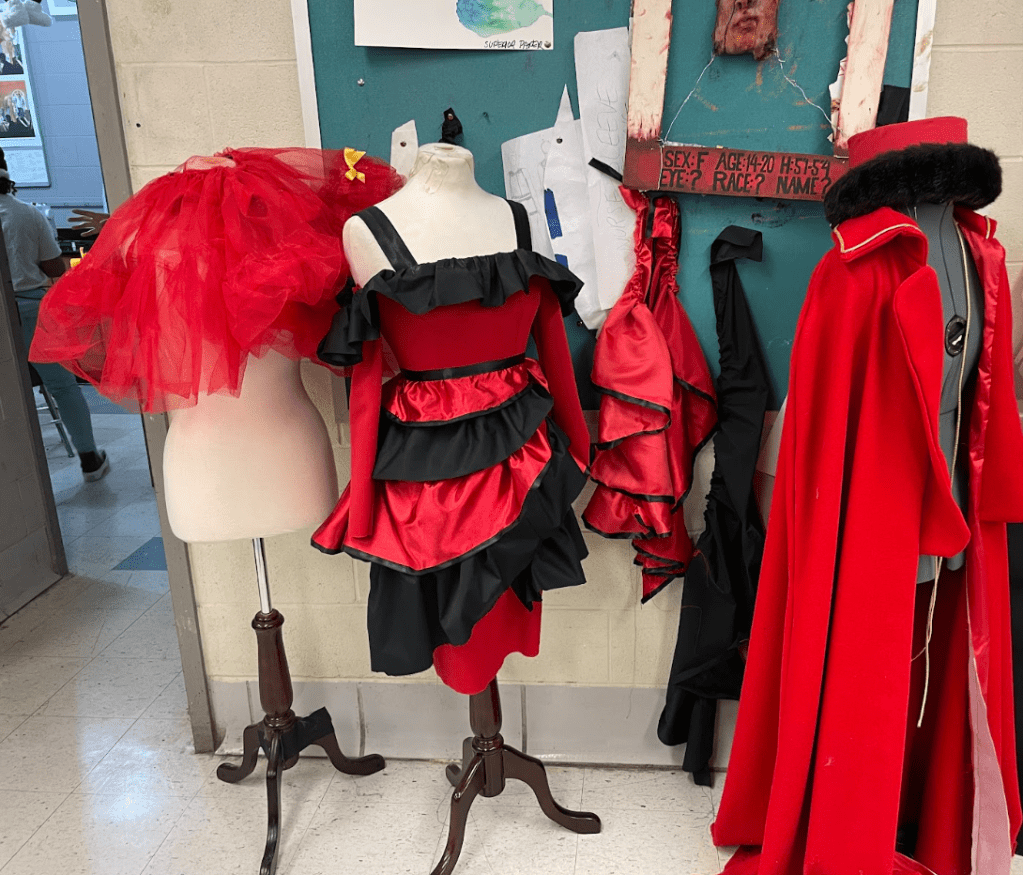
Costume Design’s Finished Costumes on Display

Irene Hong pushing a fellow stage member down the stage

Rehearsal of Musical Number Quiet
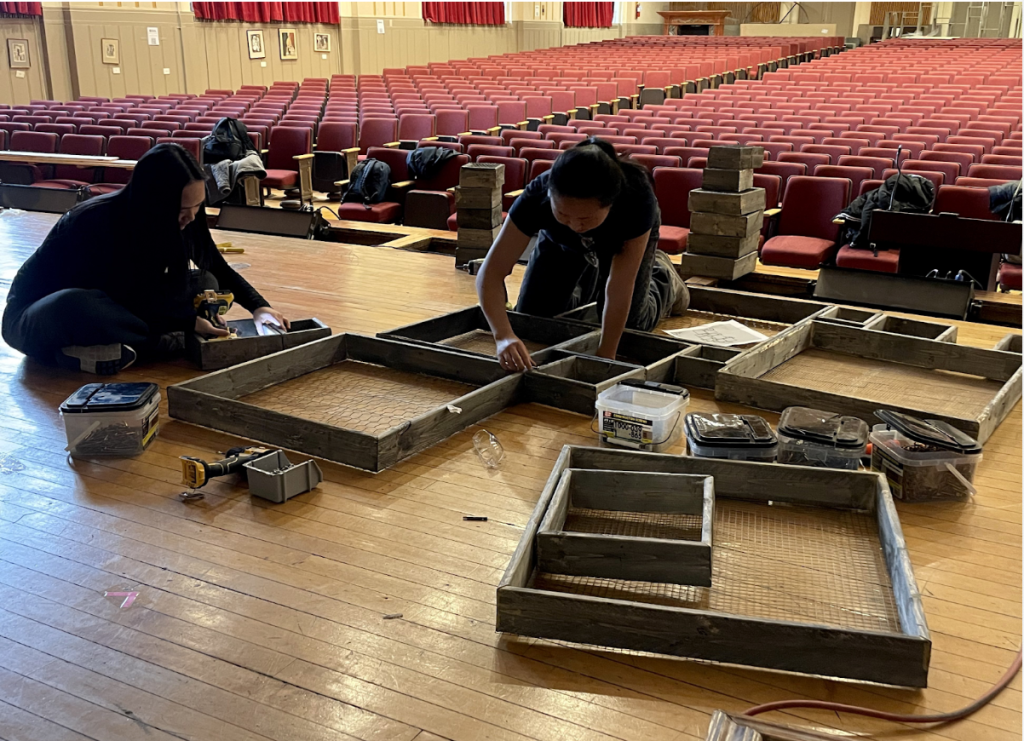
Valarie Qiu and Irene Hong putting together props for Trunchbull’s office

Stage Crew members working after cast members have cleared out




 Centralizer